- Female director pay up 94% in five years vs 36% increase for male directors
- Rise in number of female executive directors is helping to close the gap
The gender pay gap on boards of FTSE 100 companies is continuing to narrow, but female board directors still earn a hefty £795k a year less than their male counterparts, shows research by Fox & Partners, the employment and partnership law specialists.
Female board directors’ pay has been increasing at a quicker rate than male directors. The average female board directors’ pay* at FTSE 100 companies has increased 94% in five years – climbing from an average of £246k in 2021 to £476k in 2026. Over the same period male directors have seen a 36% increase in their average remuneration from £935k to £1.27m.
Catriona Watt, Partner at Fox & Partners, says that the closure in the gap is largely driven by the increase in the number of women now being made executive directors – as opposed to being made non-executive directors.
In 2026, there were 51 women in executive director positions at FTSE 100 companies, an increase from 43 women in 2024 and 34 women five years ago. Despite this, there are still significantly less females than males in executive roles – in 2026, there are 169 male executive directors – 3.3 times more executive positions filled by men than women.
Catriona Watt says: “Further positive progress has been made in closing the gender pay gap for directors of the UK’s largest companies, but the data shows a lot is yet to be done to achieve equality.”
“A rise in the numbers of female executive directors has helped, but we are still seeing over three times the number of executive roles being filled by men.”
“Female FTSE100 directors earn just 37% of male directors pay, however that is an improvement on the 27% of male director pay from five years ago.”
When FTSE100 companies sought to improve the gender diversity on their boards they largely did this by appointing women to non-executive roles – which are typically part time and more poorly remunerated than executive positions. That balance between non-exec and exec roles is now changing.
Explains Catriona: “The UK’s biggest companies have a responsibility to set a precedent in achieving better pay equality, however at the board level that equality is still a way off. However, appointing more females to executive roles is a crucial step.”
On average today, male executive board directors at FTSE 100 companies earn 21% more than female execs, and male non-executive directors earn 25% more than female non-execs.
Catriona Watt adds: “Undertaking full and detailed market reviews on salaries, setting targets, reviewing policies and culture, and investing in programmes and opportunities targeted at women are methods FTSE 100s should adopt to help close the gap.”
Lloyds Banking Group, for example, has invested in programmes such as Elevate, which supports women progressing into senior roles in traditionally male-dominated areas such as technology and data.
Natwest has set up a Gender Network Development Programme to help women develop the ‘confidence, skills and networks’ to progress their careers. Training, coaching and workshops are provided, concluding with a ‘Dragons’ Den’ style presentation to senior management, giving them direct contact with senior decision makers and helping build vital leadership skills.
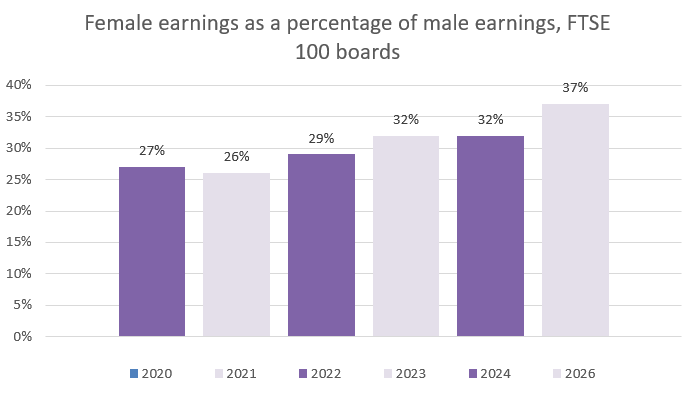
*Total remuneration
Coverage